Chronological History of Video Games:
Early History of Video Games (1951-1971)
___________________
 |
| IBM Model 7030, also known as "Stretch." |
Various types of graphics displays from many manufacturers were introduced in the mid-1960s, opening the door to new video effects. Thus, we find a video pool game developed at RCA (1967), a ball-and-paddle game by Ralph Baer at Sanders Associates (1967, later to become the Magnavox Odyssey home video game in 1972), a rocket car simulation by Judah Schwartz at MIT (1968), a graphic flight simulation by the computer firm Evans & Sutherland (1969), a lunar lander game at DEC (1969), and a device to permit computer output and standard television video on the same display at Stanford (1968).
Costing only a nickel a play, pinball games flourished as a source of cheap entertainment during the Depression and the Second World War, and they were popular enough that their prices rose to a quarter (today some even charge 50 cents or more). Other arcade games that were even closer to video games were electromechanical games like Sega’s first game, Periscope (1968), and Chicago Coin Machine Company’s Apollo Moon Shot Rifle (1969), which featured upright cabinets and game controls under a screen (but no video monitors). These games were coin-operated and relied on mechanical figures staged inside the game’s cabinet, some with mechanical sound effects as well. These games, perhaps more than any others, helped to pave the way for video games, which were, for arcade players, yet another technological development in the world of arcade coin-operated gaming.
Also in the late 1960s, both DEC and Hewlett-Packard started major marketing efforts to sell computers to secondary and elementary schools. As a result, both companies sponsored a number of small-scale projects to write computer games and simulations in various fields, many of which were released in the early 1970s. In DEC’s King game (later called Hammurabi), for example, players must decide how much land to buy, sell, and cultivate each year, how much to feed the people, etc., while dealing with problems of industrial development, pollution, and tourism.
------------------
It's hard to pinpoint any true "firsts" when researching videogame history. It seems like you can just keep going back and back, forever finding new items that "influenced" in some way the development of videogames. And honestly, this period is the least exciting to me, if only because the games themselves were still just demo's and ideas mostly. But, I think it's good to point out some of the influential and important milestones through the decades:
 |
The "Nimrod" Computer |
1951 - The "Nimrod" machine was on display at the World's Fair, challenging anybody to beat it at a game of NIM. Really trippy sci-fi stuff here. Dismantled for other things after the Fair, what a shame.
1952 - "Naughts and Crosses" (or "OXO") written by a Cambridge University student - Alexander S. Douglas. Shortly after was cast aside, thinking of it as a simple program merely to prove a point.
- Early Military simulation games programmed by Bob Chapman and others. That same year some formula games (like NIM) and dictionary look-up games (Tic-Tac-Toe, etc.) were programmed for early computers
1953 - Arthur Samuel demonstrates
Checkers on an IBM 701 computer.
1954 - 1st computer game of Blackjack for the IBM 701, and a crude game of pool was written at University of Michigan.
1955 - Hutspiel - The first theater-level war game (NATO vs. USSR) was programmed
1956 - The first version of computer chess was actually programmed by James Kister, Paul Stein, Stanislaw Ulam, William Walden, and Mark Wells on the MANIAC-1 at the Los Alamos Atomic Energy Laboratory. The game was played on a simplified 6 x 6 board and examined all possible moves two levels deep at the rate of 12 moves per minute.
1957 - Alex Bernstein writes the first
complete computer chess program on an IBM-704 computer—a program advanced enough to evaluate four half-moves ahead.
 |
| Higginbotham's Tennis for Two |
1958 - William Higginbotham's Tennis for Two experiment shown at Brookhaven Laboratory. This was a game played on an oscilloscope display, and was actually the first game to allow two players simultaneous control of the direction and motion of the objects. Gravity, bounce, and even wind speed were calculated into game play... the earliest PONG! Though many today do not consider this to have been a real video game, others consider it to be the FIRST actual video game (2-player).
1959 - The Management Game - an early simulation game with simulated competition between three companies in the detergent industry and integrated modules on marketing, production, finance, and research. Pretty sweet! I'd want to play that today, although it would be so out of touch with current markets. Actually, this game has been updated and revised and is still in use in schools of business today - making it quite possibly the longest-running game ever created.
 |
| Spacewar! (1962) |
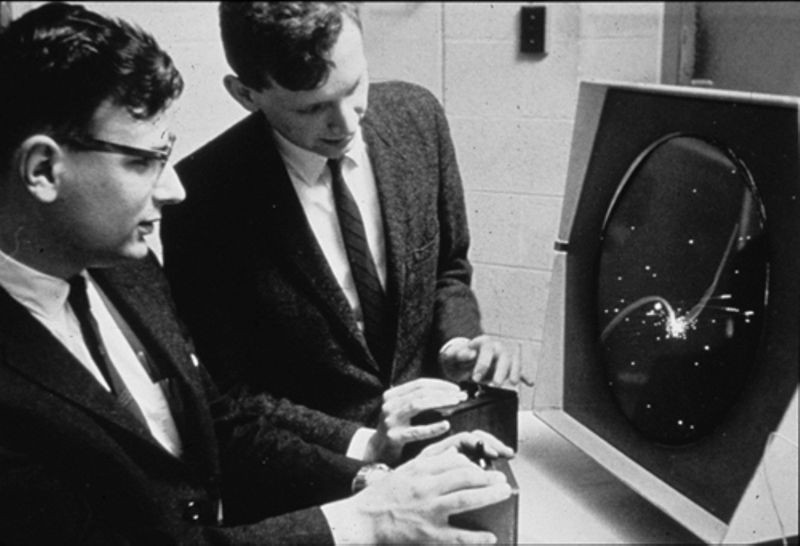
1962 - The finished version of the mainframe computer game
SPACEWAR! is written at MIT by Steve Russell. 1962 IBM catalog even lists it for purchase. Spacewar! is probably the best known game that came from the mainframe era. This was a time when computers were still giant machines that were available at large corporations and college campuses. Games were quite limited, as space was limited and expensive.
Although Spacewar! had a version for the Atari 2600, it wasn't the same game. Basically consisting of a "needle" and a "wedge" you flew around space trying to shoot each other. There was a sun in the middle with gravity that sucked you in, and you could hit the hyperspace button to disappear and reappear somewhere else. Spacewar! was created in part as a demonstration of the new (DEC) PDP-l!
1966 - Ralph Baer writes a four-page paper describing his ideas for playing interactive games on ordinary television sets. The TRUE father of video games. In 1967 he even has a light gun prototype and a working "ping-pong" game. He applies for his patents in 1968... is displaying a DEMO unit by 1969!
-
Eliza is programmed into mainframe computers. It was a primitive natural language simulator, and it had modes like Doctor - which tried to simulate a typical psychoanalysts response to your statements.
For example:
"My Mother Doesn't Love Me" might get a response -
"Who else in your family doesn't love you?"
 |
| Some wisdom from Eliza... or not! |
I remember a similar game that I played early on with my Commodore 64. It was "Dr. Sbaitso" and showcased the Creative Labs Sound Blaster. Very similar in structure to Eliza. Anyway, it was this attempt to create a human response that was so inventive, and indeed influenced the natural language parsers of early games like "Adventure" and "DND".
 |
| Ralph Baer's video game system in development |
1967 - Baer has a light gun prototype and working "ping-pong" type game. Three dials (vertical, horizontal and "English") - NOTE: this is the stupidest use of the word "English" which generally means to put a spin on a ball to affect it's path. I say this because the "English" dial here just moves the ball itself in either direction - as much as you turn the dial. So the dial should've just been "ball control"
1968 - Baer applies for a patent for his TV video game system. And then he starts to shop the concept around to a number of less than enthusiastic companies. Video games are just not a thing. Hard to convince sales when they don't even know what to do with it.
1969 - Baer's brown box demo for his concepts. Also, the game
Hamurabi is released... one of the very earliest strategy/resource management games.
 |
| The moon landing movie set *wink |
Also
in 1969 was the Moon landing! What a year. The Lunar Lander game comes out on PDP-8... and a long tradition begins. And the ARPANET delivers the first message sent from one school to another. Although there is some debate about it.. the first microprocessor might have been created for the military.
Jan 1, 1970 - UNIX time begins. It's the official clock of many computers, monitoring unix time down to the very second since this inception. Also, it seems there are precious few games in 1970. Like the calm before the proverbial storm. Stay tuned.