Original Platform: PDP-1 mainframe
Best: PDP-1 mainframe
SHROT REVIEW:
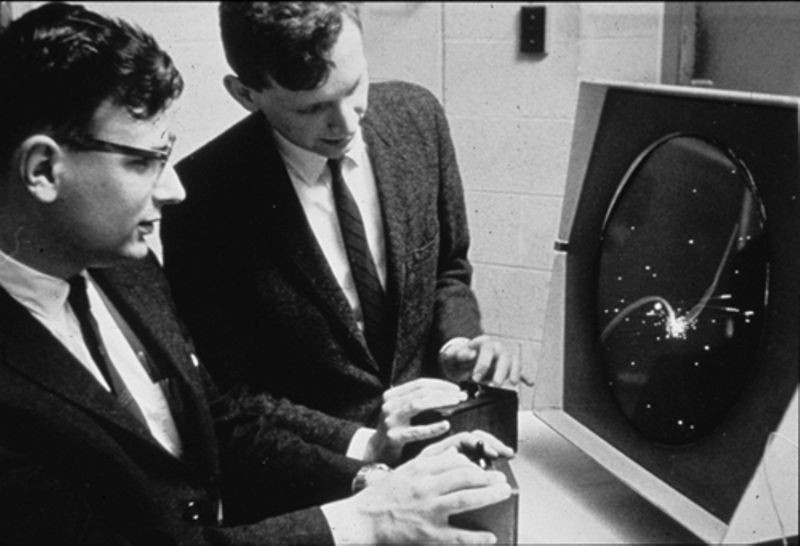
As I embark on a quest to find over 2000+ video games worthy of a future book that I'm thinking of... Spacewar! might be just about the best place to start. To me its the first true "game" in all of video game history that feels like the beginning. There simulations and games before to be sure... but this was something new, something different.Spacewar is partly responsible for starting an industry. Maybe not directly… but it's influence on other luminaries like Nolan Bushnell is almost a direct through-line to the beginning of the video-game industry. Where else but on a powerful minicomputer could you get a space-shooter video game in 1962? If you were one of the privileged college students at MIT… then you might have been lucky enough to have seen or even played this ground-breaking game.
It didn't burst into existence fully formed... but various programming efforts kept refining the play mechanics. The heft of the gravity, the look of the ships... adding a sun with gravity in the center, replacing a random starfield with an actual map of real stars with their relative brightness. You see, it wasn't thought of as simply "programming a video game"… this was a learning experiment. There was no attempts at creating a commercial product, it was just experimenting with the tech, having a good time, and proudly showing off your creation.
When Nolan Bushnell tried to create a commercial arcade video-game in 1971, he was trying to recreate the Spacewar! experience he found so fascinating. Computer Space was his attempt at bringing this classic to the coin-op arcades in an affordable manner (more on that once we get there). The point being that this game was one of the big inspirations to Nolan, and others.
Many who enjoy video games have experienced that "Aha!" moment when they first got that happy buzz... a first hit of wonder & fascination with videogames. For a rare few back in the 60's… that wonder was sparked by Spacewar! And for that, I feel it's an appropriate beginning on the journey we're about to embark across the galaxy of games worth highlighting from the last 50+ years.
When Nolan Bushnell tried to create a commercial arcade video-game in 1971, he was trying to recreate the Spacewar! experience he found so fascinating. Computer Space was his attempt at bringing this classic to the coin-op arcades in an affordable manner (more on that once we get there). The point being that this game was one of the big inspirations to Nolan, and others.
Many who enjoy video games have experienced that "Aha!" moment when they first got that happy buzz... a first hit of wonder & fascination with videogames. For a rare few back in the 60's… that wonder was sparked by Spacewar! And for that, I feel it's an appropriate beginning on the journey we're about to embark across the galaxy of games worth highlighting from the last 50+ years.
My goal is to keep the reviews short but meaningful. Almost everything I want to highlight has probably been covered more in-depth elsewhere... but I hope to present more like a highlight reel with this blog.
VIDEO:

